Candidate Story : (Questions are listed after the story
I am Sanjay. Five times I walked into CDM interviews with full confidence, and five times I came out with a rejection mail. I was 32, still earning just 80k a month, watching my friends buy cars and houses while I kept explaining to my family, “Next time pakka.”
I finally got tired of failing. I stopped mugging up basic questions and started learning the real tough stuff of Study Start-Up – eCRF design, DVP, SDTM mapping, RACI matrix, and all those things that actually run a clinical trial. I practiced day and night like a student again.
Today I am earning ₹1.6 Lakh per month in a good company. The same questions that once rejected me are now the reason companies fight to hire me.
Interview Questions for Study Start Up (SSU)-CDM
These are deep, scenario-based, and core to Study Start-Up.
1. How do you ensure completeness and accuracy of the eCRF design during Study Start-Up, especially when the protocol is still in draft?
Answer:
Perform iterative eCRF reviews aligned with the final protocol version, using annotated CRF (aCRF) and cross-referencing with the Data Management Plan (DMP). Conduct mock data entry with the study team to identify gaps in visit structure, edit checks, and derived fields before database lock readiness.
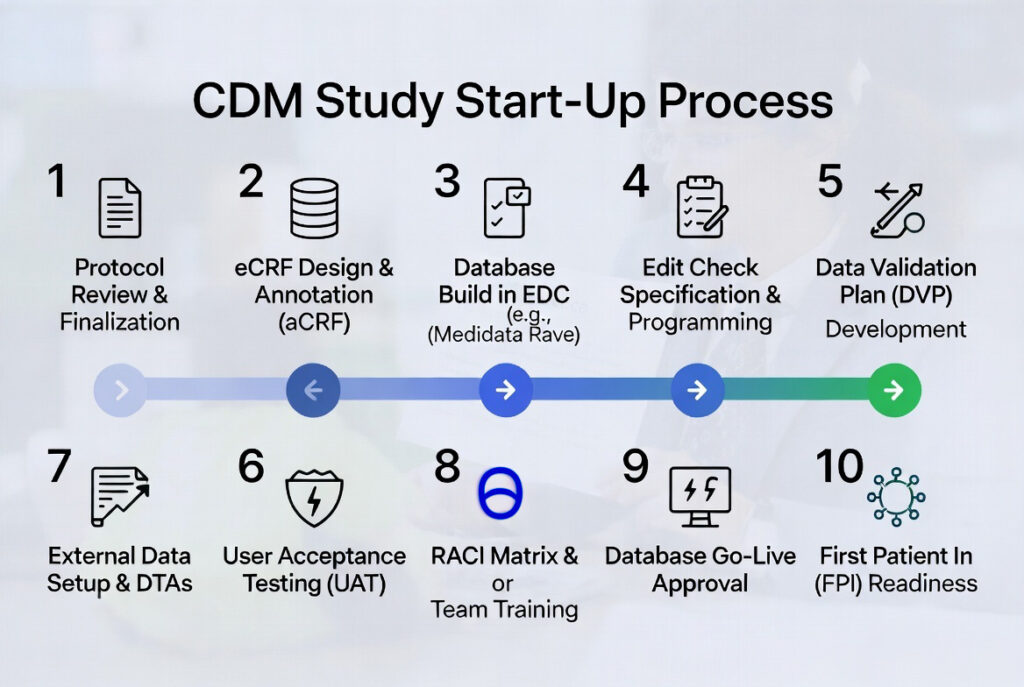
2. Explain the process of building a robust Data Validation Plan (DVP) during Study Start-Up and how it integrates with the Statistical Analysis Plan (SAP).
Answer:
The DVP is built by translating protocol requirements, SAP-derived variables, and medical review needs into programmable edit checks (univariate, multivariate, and logical). It must be reviewed and approved by Data Management, Biostatistics, and Medical Monitors before first patient in (FPI) to ensure consistency between data collection and analysis outputs.
3. What are the critical risks in EDC database build during Study Start-Up, and how do you mitigate them in a tight timeline?
Answer:
Key risks include misaligned visit schedules, incorrect derivation logic, and missing SDTM mapping. Mitigate by using a parallel build approach with UAT (User Acceptance Testing) in multiple rounds, involving cross-functional SMEs, and maintaining a detailed traceability matrix from protocol to EDC fields.
4. Describe how you handle the integration of external data sources (e.g., labs, ePRO, biomarkers) during CDM Study Start-Up.
Answer:
Develop detailed Data Transfer Agreements (DTAs) and specifications early, including file format, frequency, and reconciliation rules. Perform rigorous mapping and validation programming during start-up, with test transfers to ensure seamless integration into the central EDC database without delays to FPI.
5. What is the role of a RACI matrix in CDM Study Start-Up, and why is it critical for multi-vendor studies?
Answer:
The RACI matrix clearly defines Responsible, Accountable, Consulted, and Informed parties for all start-up deliverables (eCRF build, DMP, DVP, UAT). In multi-vendor setups, it prevents ownership gaps, reduces escalations, and ensures timely database go-live by aligning CRO, sponsor, and technology vendors.
6. How do you manage protocol amendments during Study Start-Up without impacting the database go-live timeline?
Answer:
Perform impact assessment immediately upon amendment receipt, prioritizing changes to eCRF, edit checks, and visit structure. Implement version control in the EDC system, conduct targeted delta UAT, and update the DMP/DVP with clear rationale while maintaining audit trail compliance.
7. Explain the importance of SDTM mapping during Study Start-Up and its impact on downstream processes.
Answer:
Early SDTM mapping during start-up ensures raw data is collected in a submission-ready format, reducing post-lock conversion efforts. It directly influences eCRF design, controlled terminology (CDISC), and derivation rules, ultimately accelerating database lock and CSR timelines.
8. What key documents must be finalized before Database Go-Live in Study Start-Up, and in what sequence?
Answer:
Critical documents include finalized protocol, DMP, DVP, eCRF/aCRF, UAT scripts & results, Data Transfer Specs, and Access Management Plan. Sequence typically starts with protocol → DMP → eCRF design → UAT → approvals before Go-Live to avoid costly post-production changes.
9. How do you perform Quality Control (QC) on the EDC database build during Study Start-Up for a complex oncology study?
Answer:
Use a risk-based QC approach focusing on high-risk areas like RECIST criteria fields, tumor assessment visits, and lab normal ranges. Perform independent double programming verification, 100% check on critical edit checks, and simulated data review to ensure data integrity before FPI.
10. Describe a challenging scenario where study start-up timelines were at risk due to delayed CRF finalization. How did you resolve it as a CDM professional?
Answer:
In such cases, implement a phased Go-Live strategy: release core forms first for FPI while scheduling non-core forms via mid-study amendment. Accelerate reviews through daily stand-ups with the study team and use provisional edit checks to maintain momentum without compromising data quality.